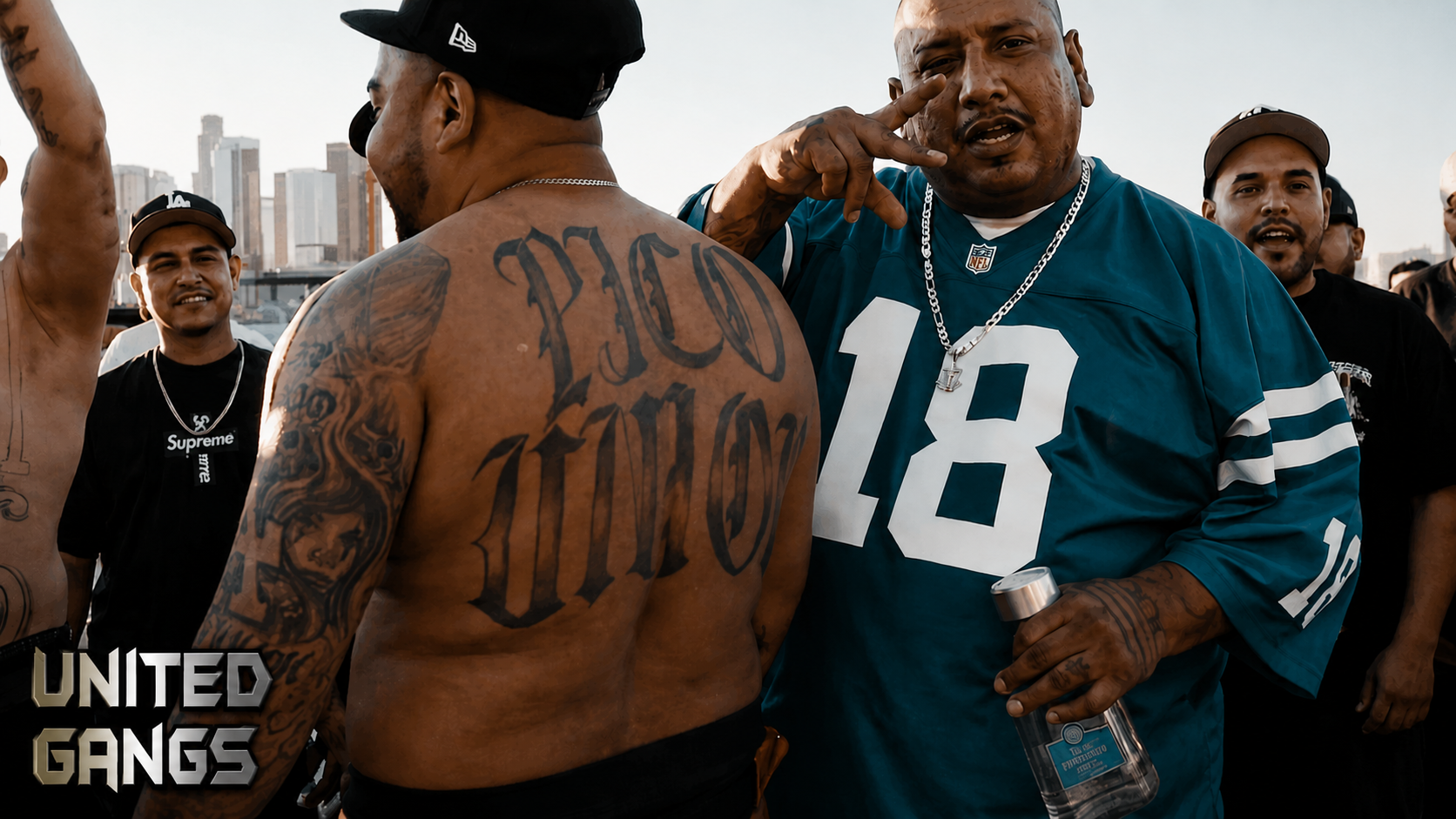
Full Name: Barrio 18th Street
Also Known As: Pico Union 18th Street, West Side 18th Street, Barrio 18, XVIII, XV3
Established: Mid-1960s
Location: Pico-Union/Westlake, Rampart District, Central Los Angeles
Original Territory: Union Avenue, Hoover Street, Arapahoe Street, and adjacent residential blocks
Ethnicity: Predominantly Hispanic (Multiethnic)
Affiliation: 18th Street Gang, Sureños
Prison Affiliation: Mexican Mafia (La Eme)
Pico-Union Cliques: Hoover Locos, Grand View Locos, Pico Locos, RED Shield
Primary Rivals: Clanton 14, MS-13, Rockwood Street Locos
Rappers: GBaby 1800,
The Pico Union 18th Street Gang is a predominantly Hispanic, multiethnic Sureño street gang based in the Pico Union and Westlake communities of Central Los Angeles. Known as the birthplace of the 18th Street Gang, Pico Union is the founding barrio from which one of Los Angeles’ largest and most geographically widespread Hispanic street gang organizations emerged.
History and Early Origins
18th Street originated during the mid-1960s in the Pico-Union and Westlake communities immediately west of Downtown Los Angeles. At the time, the area surrounding 18th Street, Union Avenue, Hoover Street, and adjacent residential blocks fell within territory claimed by Westside Clanton 14, one of Los Angeles’ oldest Hispanic street gangs.
As Clanton’s membership expanded, younger members proposed establishing a new clique known as Clanton 18th Street. The proposal would have admitted recent immigrants and other neighborhood youths who did not meet Clanton’s traditional membership requirements. Senior members rejected the proposal, believing another clique would weaken the existing neighborhood and alter its identity.
Rather than abandoning the proposal, the younger members separated from Clanton and established an independent barrio that became known simply as 18th Street. The split marked the beginning of one of Los Angeles’ longest-running Hispanic gang rivalries while establishing the original neighborhood of what would later become the broader 18th Street organization.
The newly formed barrio adopted a broader recruiting policy than many traditional Hispanic gangs operating at the time. As immigration reshaped Pico-Union and southern Westlake during the 1960s, Rampart 18th Street recruited Mexican Americans, Salvadorans, Guatemalans, Hondurans, African Americans, and other neighborhood youths regardless of race or national origin.
As membership increased, the barrio expanded beyond its original streets.
During the 1970s and 1980s, members established new 18th Street neighborhoods throughout Los Angeles County using the same neighborhood-based clique structure first developed in Rampart. Although each barrio developed its own territory, leadership, and rivalries, all traced their historical origins to the original Rampart neighborhood.
Territory & Cliques
Barrio 18th Street occupies portions of Pico-Union and southern Westlake centered around 18th Street, Union Avenue, Hoover Street, Arapahoe Street, and the surrounding residential blocks. The barrio is organized into several neighborhood cliques representing different sections of its original territory. The oldest documented 18th Street cliques remain concentrated within Pico-Union.
Hoover Locos occupies the Hoover Street corridor and has appeared in numerous criminal prosecutions, gang injunctions, and civil enforcement actions involving the Pico-Union community. Grand View Locos is centered around the Grand View Street corridor and formed part of the neighborhood’s earliest internal organization.
Pico Locos occupies the area surrounding Pico Boulevard and forms part of the original core of Rampart 18th Street.
Documented Incidents
Rampart CRASH Assault of Ismael Jimenez (1998)
On February 26, 1998, Rampart CRASH officer Brian Hewitt detained documented 18th Street member Ismael Jimenez and transported him to the Rampart Division station for questioning. According to later investigations, Hewitt repeatedly assaulted the handcuffed Jimenez until he vomited blood. After his release, Jimenez sought emergency medical treatment and filed a federal civil rights lawsuit against the City of Los Angeles.
The assault became part of the broader Rampart CRASH corruption scandal that exposed widespread misconduct within the LAPD’s anti-gang unit. Hewitt was dismissed from the department, and the City of Los Angeles later agreed to pay Jimenez a $231,000 settlement. The scandal resulted in overturned convictions, criminal prosecutions, civil settlements, and sweeping reforms within the Los Angeles Police Department.
Rampart Gang Injunctions (1999–2002)
Beginning in 1999, the Los Angeles City Attorney obtained civil gang injunctions targeting documented 18th Street members operating throughout the Pico-Union and Rampart communities. The injunctions prohibited identified gang members from associating in public, intimidating witnesses, possessing weapons, acting as lookouts, or engaging in other specified activities within designated safety zones.
Following revelations surrounding the Rampart CRASH scandal, enforcement of several injunctions was temporarily suspended while prosecutors reviewed evidence connected to officers implicated in misconduct. After additional review, the injunctions were refiled and enforcement resumed during the early 2000s.
Civil Nuisance Lawsuit Against Hoover Locos Leadership (2008)
In 2008, the Los Angeles City Attorney filed a civil nuisance lawsuit against imprisoned leaders associated with the Hoover Locos clique. Rather than seeking additional criminal convictions, the City pursued financial damages on behalf of residents and businesses affected by alleged gang activity within the Pico-Union community.
Prosecutors alleged that imprisoned gang leaders continued directing extortion schemes and collecting “street taxes” from narcotics traffickers and local businesses despite their incarceration. The lawsuit reflected the City’s broader strategy of using civil litigation alongside criminal prosecutions to disrupt established gang leadership within the Pico-Union neighborhood.
Allies & Rivals
As part of the larger Sureño prison structure, incarcerated 18th Street members have historically fallen under the authority of the Mexican Mafia (La Eme). 18th Street maintains longstanding rivalries with Westside Clanton 14, Mara Salvatrucha (MS-13), Rockwood Street Locos, Drifters 13, Burlington Street Locos 13, West Side Harpys, and Crazy Riders 13.